

Alt text: Older woman and adult son reviewing a home care checklist at a kitchen table while a caregiver stands nearby.
Most home care agencies in Sarasota describe themselves the same way: compassionate, trusted, experienced. That language tells you almost nothing, because every agency uses it. The real way to tell a well-run agency from a struggling one is to ask a short list of direct questions that have verifiable answers. The two that matter most are caregiver turnover and whether the agency tracks continuity of care, because together they decide whether your parent sees the same familiar people every week or a rotating cast of strangers.
At Seniors Helping Seniors® Suncoast, we tell families to ask us those questions, and to ask every agency on their list. Most cannot answer them. Industry-wide caregiver turnover has run near 80% in recent years, and most agencies do not measure continuity of care at all. An agency that can give you both numbers is unusual, and that alone tells you something about how it operates.
This guide walks through the questions a family should ask any agency in Sarasota, Bradenton, Lakewood Ranch, Siesta Key, Palmer Ranch, Venice, or Palmetto. You can use it whether or not you ever call us.
The questions that separate a good agency from a bad one:
- What is your caregiver turnover rate, and do you track continuity of care?
- Are you licensed in Florida, and what type of license?
- Does every caregiver clear Level 2 background screening before the first shift?
- Are you bonded and insured?
- How do you match a caregiver to a client?
- Can you provide both companion help and hands-on personal care, and scale as needs change?
- Who does the in-home assessment, and how fast can care start?
- How does billing work, and which payer programs are you contracted with?
Why choosing an agency in Sarasota feels so hard
Sarasota County is one of the oldest communities in the country. According to Census Bureau data, about 38% of residents are 65 or older, more than double the national share, and the median age sits near 57. That means the local home care market is large, crowded, and uneven in quality. There are good agencies and there are agencies that look identical on paper but fall apart in practice.
You cannot tell them apart from a website. So the decision has to come down to what an agency can prove when you ask. The rest of this guide is those questions.
Start with caregiver turnover and continuity of care
This is the most revealing question you can ask, and it is the one most agencies dread.
High turnover means a new caregiver every few weeks. For the family, that is exhausting: re-explaining your parent’s routines, medications, and preferences to a stranger over and over. For your parent, it can be unsafe. A caregiver who knows someone well notices when something changes, a new unsteadiness on the stairs, a skipped meal, early confusion. A caregiver meeting your parent for the first time has no baseline to notice against.
Ask two specific questions:
- What is your caregiver turnover rate?
- Do you track continuity of care?
For context, industry-wide caregiver turnover has hovered between roughly 65% and 80% for nearly a decade and reached 79.2% in 2023, according to the annual Activated Insights benchmarking report.
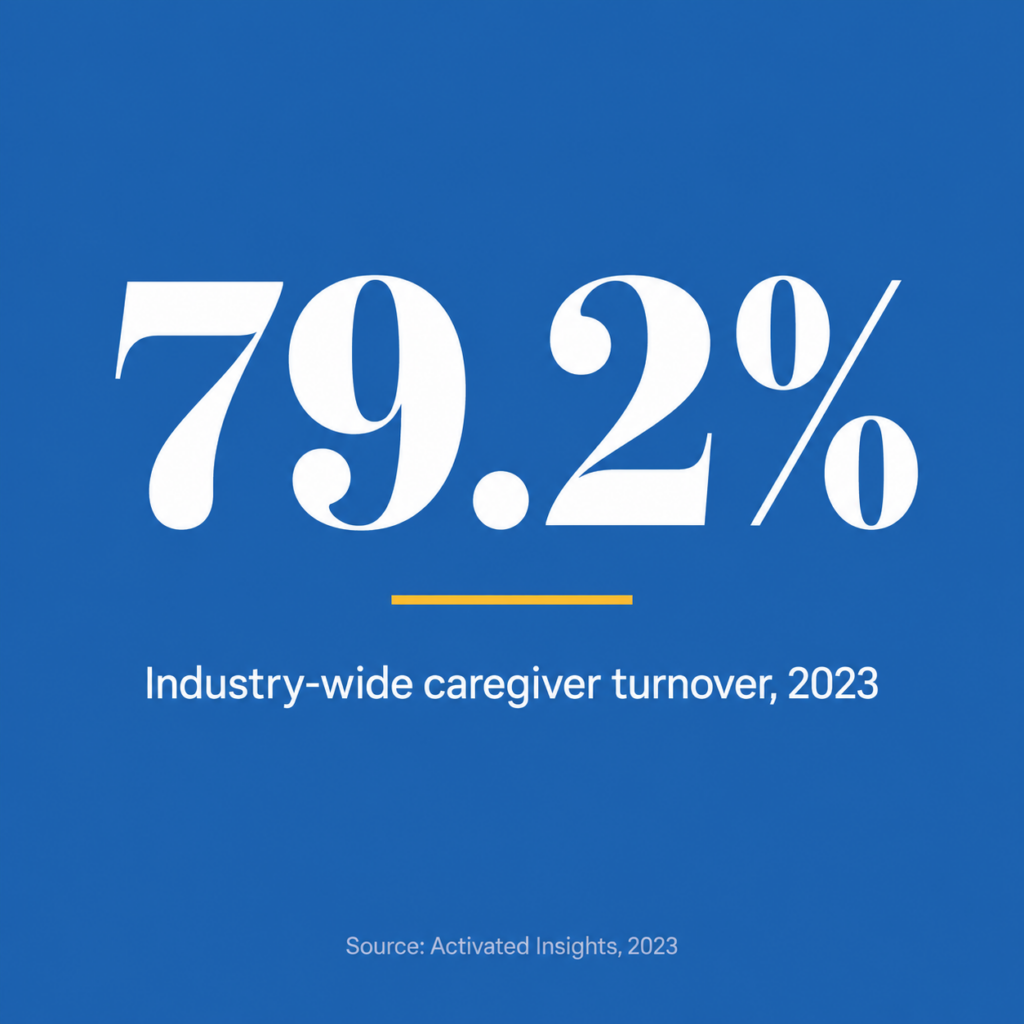
The Home Care Association of America, citing the same study, notes that nearly four out of five caregivers leave within their first 100 days. Those numbers are why this question works as a filter. An agency that can state its turnover rate is signaling operational discipline that most cannot.
Continuity of care is the second half. Turnover measures who leaves; continuity measures whether the same caregivers stay assigned to the same clients over time. Most agencies do not measure it at all. The ones that do use a defined metric. At Seniors Helping Seniors, we track a Continuity of Care Index to confirm the same caregivers stay with the same clients, and our turnover runs well below the industry range. We encourage families to ask us for both numbers, and to treat any agency that cannot answer as a warning sign.
Treat continuity as a standard you are entitled to demand, not a bonus.
Verify the Florida license yourself
You do not have to take an agency’s word that it is licensed. Florida’s Agency for Health Care Administration regulates in-home care providers, and anyone can look up a provider on the public FloridaHealthFinder facility locator by name, city, ZIP, county, or license number.
The license type matters because it tells you what an agency is legally allowed to do. Florida draws a hard line between hands-off help and hands-on care.
| Provider type | How to recognize it | What it can do | Key limitation |
| Home Health Agency | Numeric license | Hands-on personal care plus homemaker and companion help | Most comprehensive; must directly provide at least one service |
| Nurse Registry | “NR” plus digits | Refers nurses and aides as independent contractors | Caregivers are independent contractors the registry does not supervise or train |
| Homemaker and Companion Services | “HCS” plus digits (a registration) | Housekeeping, meals, errands, companionship | Cannot legally provide any hands-on personal care |
This distinction has real consequences. A homemaker and companion registrant cannot legally help with bathing or mobility, so if your parent’s needs grow, you may have to switch agencies during a crisis. For reference, our Sarasota and Manatee County operation holds Florida licenses #299995918 (Sarasota) and #299995251 (Manatee), both verifiable on the state locator.
Confirm Level 2 background screening
Someone is going to be alone in your parent’s home. Background screening is not a place to accept a vague answer.
Ask directly: does every caregiver who enters the home clear Level 2 screening before the first shift? Florida’s Level 2 background screening is the state’s highest tier. It is fingerprint based and runs both state and national criminal history checks through the Care Provider Background Screening Clearinghouse. It is required by statute for people in positions of trust who care for vulnerable adults.
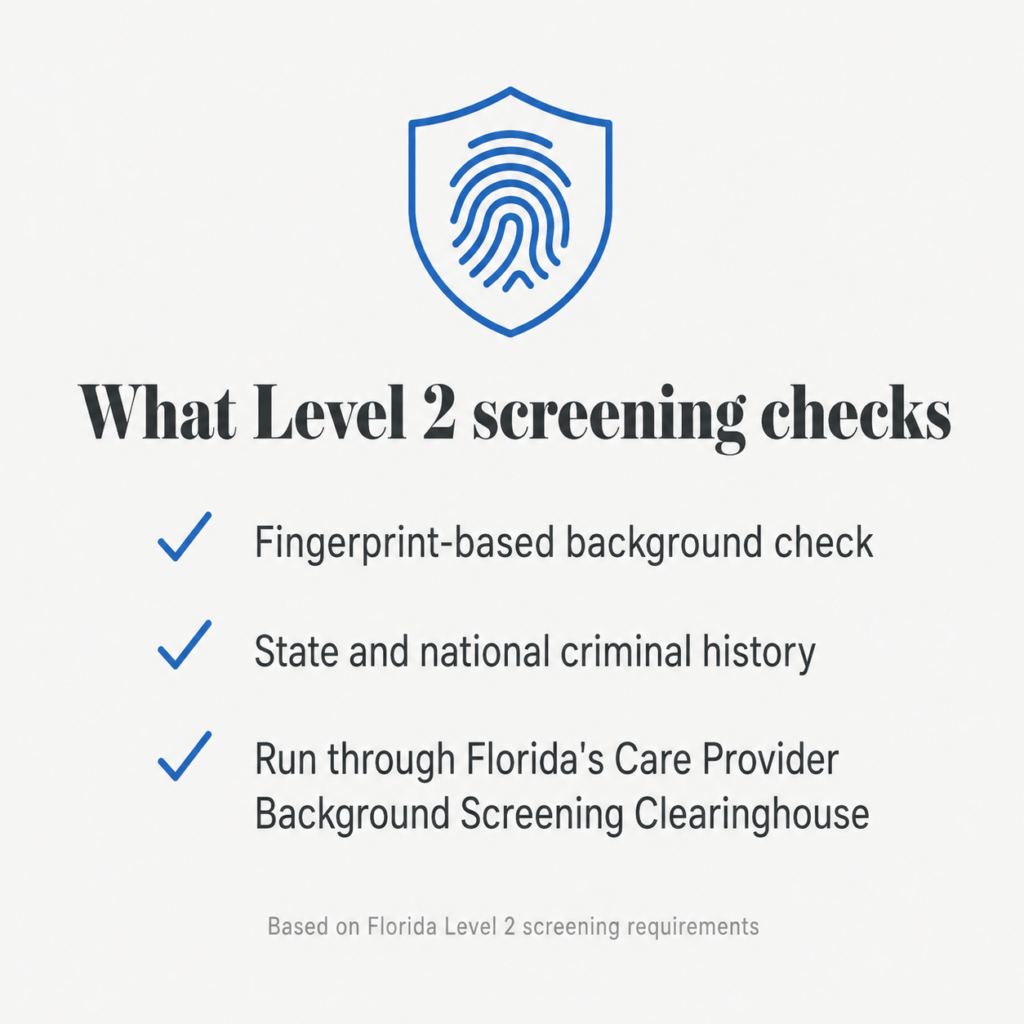
A confident agency answers this without hesitation: yes, every caregiver, before their first shift, without exception. Hedging, or uncertainty about who gets screened and when, is a red flag. At Seniors Helping Seniors, every caregiver clears Level 2 screening through the Clearinghouse before providing any care.
Check that the agency is bonded and insured
This one is short and practical. Ask whether the agency is bonded and insured, and what that coverage protects you from.
Bonding and insurance shield the family if something goes wrong, from an accident in the home to a workers’ compensation claim if a caregiver is injured on the job. The coverage you want to hear about includes general liability, professional liability, and workers’ compensation. An agency that carries all three has taken on the risk so you do not have to. A caregiver hired privately off a classified ad usually leaves that exposure with the family.
Ask how caregivers are matched
Good matching is not “we send whoever is free.” Ask the agency how it pairs a caregiver with a client, and listen for whether the answer accounts for the things that actually make a relationship work.
A strong matching process considers:
- Skill set, so the caregiver can handle the care your parent needs
- Personality, so the two genuinely get along
- Proximity, so the same caregiver can reliably show up
- Availability, so the schedule holds together over time
Matching and continuity are connected. A thoughtful match is far more likely to last, which is what keeps the same familiar caregiver coming back. We match clients after an in-home assessment based on skill set, availability, proximity, and personality, and we narrow the choice further using temperament and any specific requests from the family. If a match is not right, a serious agency changes it quickly rather than forcing a pairing that does not work.
Make sure the agency can handle the care your parent needs now and later
Before you compare agencies, get clear on what you actually need, then ask whether the agency can cover it as needs change.
Home care generally falls into two categories:
- Companion and homemaker help. Non-hands-on support such as light housekeeping, meal preparation, errands, medication reminders, rides to appointments, and companionship. Caregivers provide reminders and help with packaging only; they cannot administer medication.
- Hands-on personal care. Physical assistance with bathing, dressing, toileting, and mobility. This is personal care, and it requires a provider authorized for hands-on services.
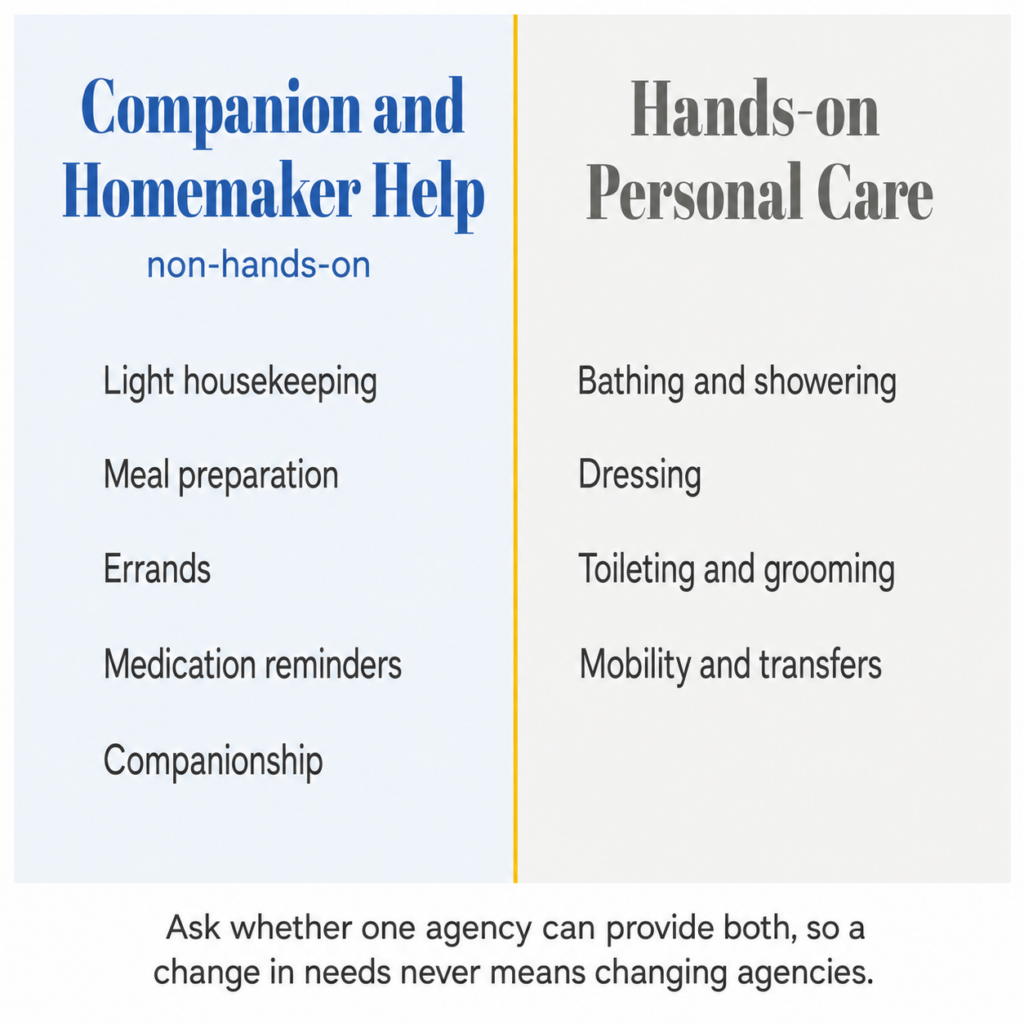
Many families start with companion help and later need personal care as a parent’s situation changes. Ask whether the agency provides both, so you are not forced to find a new provider in six months. If memory is a concern, ask specifically whether the agency offers dementia support services, which provide supervision, companionship, and structured social interaction for people living with cognitive decline. An agency that can scale across all of these as needs grow saves you from changing agencies mid-crisis.
Ask who does the in-home assessment and how fast care can start
A serious agency does not start care by sending a stranger to the door. It assesses the home first.
Ask two things: who conducts the in-home assessment, and how quickly it happens. A nurse-led assessment signals an agency that takes safety and matching seriously. The nurse evaluates your parent’s care needs and the home environment, including fall prevention factors like grab bars, walk-in showers, throw rugs, and clutter in walkways.
At Seniors Helping Seniors, a registered nurse conducts an in-home assessment, typically within 24 to 48 hours of the first call, before care begins.
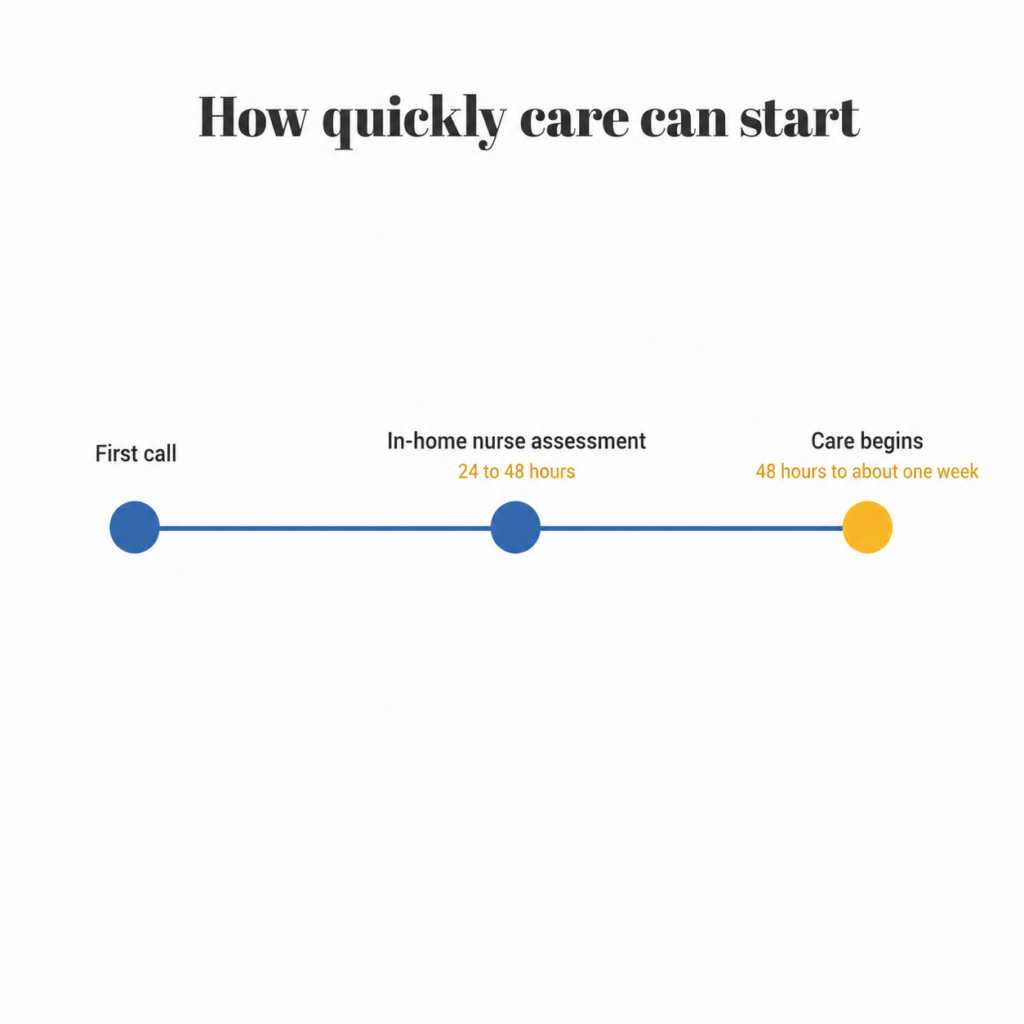
From the first phone call to the start of care, the timeline usually runs from 48 hours to about a week, depending on how complex the schedule is.
Understand how billing works and which programs may pay
Cost is a structural question, not a single number quoted over the phone. The right questions are about how billing is set up.
Ask:
- Is care billed hourly?
- Is there a large upfront payment or deposit?
- Is there a minimum number of hours per week?
- Could a funded program cover the cost entirely?
A reputable agency bills clearly and does not demand a large payment before any care is delivered. We bill every other week for care already provided, with no upfront payment required, and we explain the structure in writing rather than quoting a bare rate out of context.
Payer contracts are the second reason to ask about money, and this one is a quiet credibility test. Agencies approved by the U.S. Department of Veterans Affairs, certain Medicare Advantage plans, the PACE program, and Florida Department of Elder Affairs programs had to meet those organizations’ standards to get contracted. Few agencies hold any one of them, and fewer hold several. Being approved across that range is a marker of vetting most competitors cannot match. You can see how these coverage options work in more detail on our paying-for-care page.
Most families pay privately, but eligible veterans and those with certain Medicare Advantage or PACE plans may have coverage options that reduce or eliminate out-of-pocket cost. One note on Medicare: traditional Medicare generally does not pay for non-medical home care, though some Medicare Advantage plans do. Veteran families should ask specifically about the VA home care program, which can fund in-home aide services, and whether the agency holds a VA contract. Eligible veterans can receive the full range of services through our home care for veterans at zero out-of-pocket cost.
For neutral guidance on which state programs your parent may qualify for, Florida’s statewide Elder Helpline is available at 1-800-963-5337.
Consider who the caregivers actually are
One last question worth asking: who are your caregivers?
There is a real difference between an agency that staffs whoever applies and one built around experienced, mature adults who share generational common ground with the people they serve. When a caregiver has lived through the same decades, the connection is natural and the companionship is genuine rather than performed. That is the foundation of the Seniors Helping Seniors model, and it is a large part of why our caregivers stay and why continuity holds. We will describe it; we will let you draw the conclusion.
A quick checklist to compare agencies
Use this when you call each agency on your list. Strong answers cluster together, and so do red flags.
| Question to ask | What a strong answer sounds like | Red flag |
| What is your caregiver turnover rate? | A specific number, well below the industry’s roughly 65% to 80% | Cannot or will not answer |
| Do you track continuity of care? | Yes, with a defined metric like a Continuity of Care Index | “We try to keep the same person,” with no measurement |
| Are you licensed, and what type? | A number you can verify on FloridaHealthFinder | Vague or evasive |
| Does every caregiver clear Level 2 screening first? | Yes, without exception, before the first shift | Uncertainty about who is screened, or when |
| Are you bonded and insured? | Yes, general and professional liability and workers’ compensation | No clear answer |
| How do you match a caregiver to a client? | Skill set, personality, proximity, and availability | “We send whoever is available” |
| Can you provide companion help and personal care? | Yes, and can scale as needs change | Only one type, forcing a switch later |
| Who does the in-home assessment, and how soon? | A nurse, typically within 24 to 48 hours | No assessment, or non-clinical |
| How does billing work? | Hourly, billed after care, no large upfront payment | Large deposits required in advance |
| Which payer programs are you contracted with? | VA, Medicare Advantage, PACE, or state elder-care programs | None |
Frequently asked questions
How do I check if a home care agency is licensed in Florida?
Look it up yourself on the state’s FloridaHealthFinder facility locator. You can search by the agency’s name, city, ZIP, county, or license number, and confirm both that the license is valid and what type it is.
What is Level 2 background screening?
Level 2 is Florida’s highest tier of background check. It is fingerprint based and runs both state and national criminal history checks through the Care Provider Background Screening Clearinghouse. Ask whether every caregiver clears it before their first shift.
What is the difference between companion care and personal care?
Companion and homemaker care covers non-hands-on help like housekeeping, meals, errands, medication reminders, and companionship. Personal care covers hands-on help with bathing, dressing, and mobility. Florida law treats these differently, so confirm an agency can provide both if needs may grow.
Does Medicare pay for in-home care in Sarasota?
Traditional Medicare generally does not pay for non-medical home care. Some Medicare Advantage plans cover it, and eligible veterans and PACE participants may have coverage as well. Ask each agency which payer programs it is contracted with.
How fast can home care start?
A well-run agency assesses the home before care begins. With us, a nurse typically completes an in-home assessment within 24 to 48 hours of the first call, and care usually starts within 48 hours to about a week, depending on the schedule.
Ready to ask us these questions?
If you are weighing agencies in Sarasota, Bradenton, Lakewood Ranch, Siesta Key, Palmer Ranch, Venice, or Palmetto, ask us everything on the checklist above. Most families start with a short 10 to 15 minute call to talk through the situation and see whether the service is the right fit, with no obligation to move forward. You can also get a free consultation or learn more about home care in Sarasota.
Seniors Helping Seniors Suncoast, 6901 Professional Pky E, Suite 266, Sarasota, FL 34240, 941-877-1000
Each office is independently owned and operated. Seniors Helping Seniors® is a registered trademark of Corporate Mutual Resources Incorporated.