
Original Medicare does not pay for ongoing non-medical home care in Florida. It covers skilled, doctor-ordered home health for a limited time, but not the daily help with bathing, dressing, meals, and companionship that lets most seniors stay in their own homes. The funding paths that actually cover ongoing personal care are VA programs, certain Medicare Advantage plans, PACE, Florida Department of Elder Affairs programs, and private pay.
At Seniors Helping Seniors® Suncoast Senior Care, we help families across Sarasota and Manatee County sort through these options every week. Most home care agencies hold few or none of these contracts. We are set up to bill across the VA, multiple Medicare Advantage plans, PACE, and four Florida elder-care programs, which matters because the way a family pays for care often changes over time. Below is a plain explanation of how each path works, so you can find the one that fits your situation.
Home Care vs. Home Health Care: Why the Difference Changes Who Pays
The terms “home health care” and “home care” sound interchangeable, but they are funded very differently. Getting this distinction right is the first step in figuring out who pays.
| Skilled home health | Custodial / personal care | |
| Type of care | Medical: nursing and therapy | Non-medical: bathing, dressing, meals, supervision |
| Who orders it | Doctor-ordered | Family-arranged |
| Duration | Intermittent and time-limited | Ongoing |
| Original Medicare | Covered at $0 when you qualify | Not covered when it is the only care needed |
The second type, custodial care, is what most seniors actually need to remain at home, and it has to be funded another way.
Which Programs Pay for Ongoing Home Care in Florida?
Here is a side-by-side look at the main payment paths and who generally qualifies for each.
| Payment path | Covers ongoing non-medical home care? | Who generally qualifies |
| Original Medicare | No (skilled, intermittent care only) | Homebound, need skilled care, doctor-certified |
| Medicare Advantage (Part C) | Sometimes, as a supplemental benefit | Plan enrollees, often “chronically ill” criteria |
| VA (Homemaker/Home Health Aide, Veteran-Directed Care) | Yes | Enrolled veterans with clinical need |
| VA Aid and Attendance / Housebound | Yes (cash added to pension) | Pension-eligible veterans or survivors with a care need |
| PACE | Yes | Age 55+, nursing-home level of care, in service area |
| Florida DOEA (CCE, ADI, HCE, Title III-E) | Yes (often limited or waitlisted) | Generally 60+, functionally impaired |
| Private pay | Yes (no restrictions) | Anyone |
Does Medicare Pay for Home Care in Florida?
Original Medicare does not pay for ongoing custodial home care when that is the only care a person needs. It is worth understanding exactly where the line falls.
Medicare’s home health benefit covers intermittent skilled nursing, physical therapy, occupational therapy, speech-language pathology, medical social services, and part-time home health aide care.
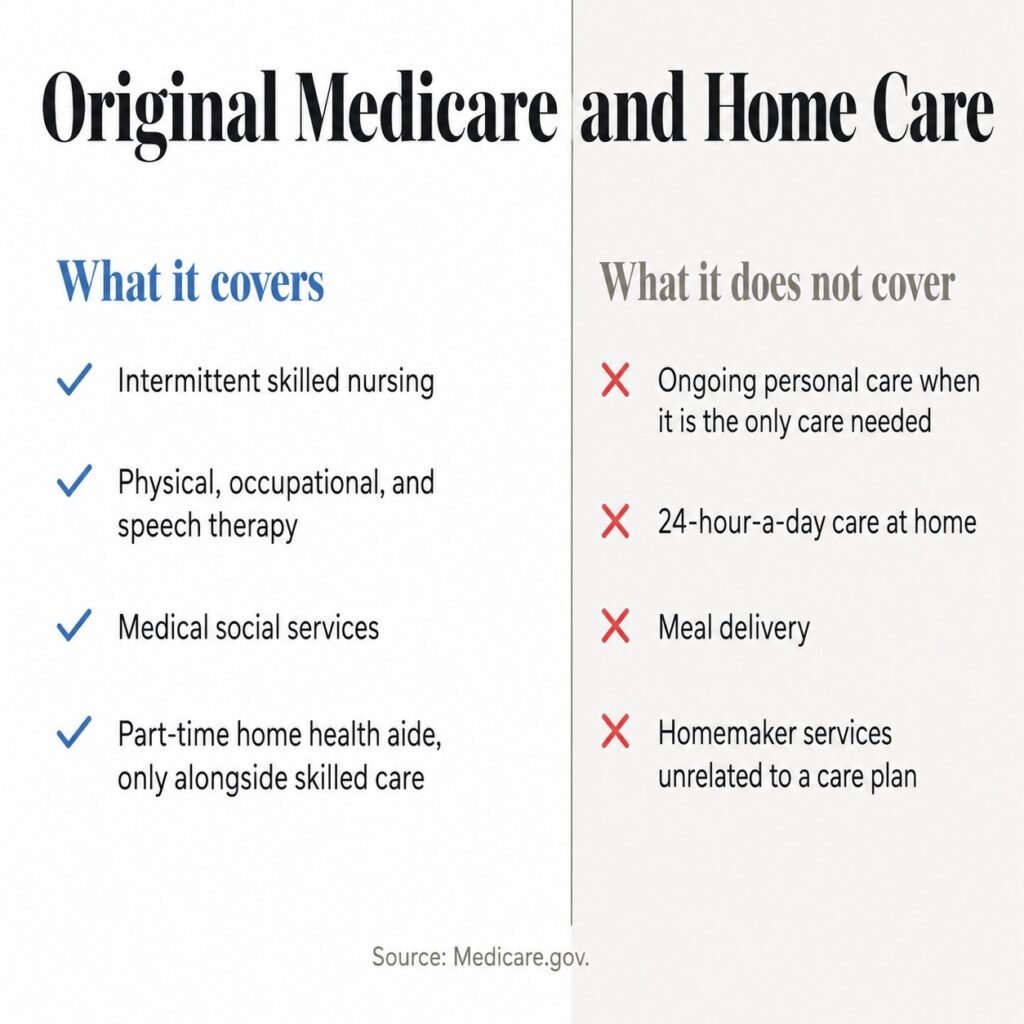
The aide care is covered only if you are also receiving skilled care at the same time. Medicare does not cover custodial or personal care when it is the only care you need, and it does not cover 24-hour-a-day care at home, meal delivery, or homemaker services unrelated to a care plan.
To qualify for Medicare home health, you generally must be under a doctor’s care plan, be certified as needing intermittent skilled care, use a Medicare-certified agency, and be certified as homebound. If you qualify, you pay $0 for covered home health services and 20% of the approved amount for durable medical equipment. “Part-time or intermittent” generally means skilled nursing and aide services combined up to 8 hours a day, for a maximum of 28 hours a week.
Medicare Advantage: The Exception Worth Checking
Some Medicare Advantage (Part C) plans now include in-home support or personal care as a supplemental benefit, which Original Medicare does not. These benefits vary widely by plan, county, and year, and are often tied to “chronically ill” eligibility criteria. Call the plan directly and ask whether it covers in-home support services, how many hours per year, and which agencies are in network. Re-check every plan year, since benefits change.
We are contracted with several Medicare Advantage plans, including Humana, UnitedHealthcare, Aetna, Longevity Health Plan, and Ultimate Health Plans.
How Veterans Can Pay for Home Care in Florida
The VA funds home care for eligible veterans, and for some surviving spouses, through several distinct paths:
- Homemaker and Home Health Aide (H/HHA) Care. A trained aide comes to the veteran’s home to help with daily activities, supervised by a registered nurse. It is available to enrolled veterans who are eligible for community care and meet the clinical criteria. The aide must work for an organization that holds a VA contract.
- Veteran-Directed Care (VDC). The veteran receives a budget, managed by themselves or a representative, and hires their own workers to help them live at home.
- Aid and Attendance (A&A) and Housebound allowances. These are increased monthly pension amounts paid as cash, which the recipient can spend on home care of their choosing. They require pension eligibility.
For families exploring the pension route, here are the current maximum annual pension rates for a veteran with no dependents:
| VA pension benefit (veteran, no dependents) | Maximum annual rate |
| Base pension | $17,441 |
| Housebound | $21,313 |
| Aid and Attendance | $29,093 |
Surviving spouses who qualify may also receive an increased pension through the Survivors Pension program. These figures adjust every December with the cost-of-living adjustment, so confirm the current numbers before relying on them.
Because we hold a VA contract, eligible veterans can receive our full range of services with zero out-of-pocket cost when care is VA-funded. You can read more about our home care for veterans and how VA funding works.
What Is PACE and Who Qualifies?
PACE, the Program of All-Inclusive Care for the Elderly, helps older adults stay in their community instead of moving to a nursing home. The model combines both medical and social services as an alternative to nursing-home care.
PACE benefits are comprehensive and include home care, adult day care, primary care, hospital care, prescription drugs, transportation, meals, and therapies. To qualify, the National PACE Association lists four requirements: you must be age 55 or older, certified by the state as needing nursing-home level of care, able to live safely in the community at the time of enrollment, and living within a PACE service area.
Cost depends on coverage. With Medicaid, participants typically pay nothing for the long-term care portion. Those with Medicare but not Medicaid pay a monthly premium, and people with neither can pay the premium privately. PACE is available in the Sarasota and Manatee area, with eligibility and enrollment handled through a local PACE organization.
Florida Department of Elder Affairs Programs
The Florida Department of Elder Affairs administers several state and federally funded programs through the state’s Area Agencies on Aging. Access begins with the Elder Helpline at 1-800-96-ELDER (1-800-963-5337), which screens callers for eligibility.
- Community Care for the Elderly (CCE). For individuals 60 and older who are functionally impaired. CCE funds personal care, homemaker services, home-delivered meals, respite, and adult day care. A sliding-scale co-payment applies based on income, with no co-payment for clients at or below the federal poverty level.
- Alzheimer’s Disease Initiative (ADI). Offers respite and support for families living with Alzheimer’s disease or related memory disorders, delivered in-home, through adult day care, or as extended care, along with caregiver training.
- Home Care for the Elderly (HCE). Supports Floridians 60 and older in family-type living arrangements with a basic monthly subsidy of $160, plus special subsidies for supplies, equipment, and home modifications.
- Older Americans Act Title III-E (National Family Caregiver Support Program). Provides respite, counseling, support groups, training, and material aid to family members caring for someone age 60 or older.
These programs are funded by limited appropriations and often maintain waitlists, so they are best treated as supplements rather than guaranteed full funding. We are an approved provider for CCE, ADI, HCE, and the Title III-E caregiver support program.
Paying Privately for Home Care in Florida
Private pay has no eligibility requirements and fills any gap immediately. It is also commonly combined with the programs above when a benefit only covers part of the hours a family needs.
For planning purposes, the third-party CareScout Cost of Care Survey (formerly Genworth) put the 2025 Florida median rate for a home health aide at about $32 per hour. At 20 hours of care per week, which is closer to what most families actually need, that comes to roughly $2,770 per month. Heavier schedules of around 44 hours per week run about $6,101 per month. Rates vary by agency depending on caregiver screening, training, and which insurance or state programs an agency is contracted with. Agencies with deeper background screening and broader payer contracts, such as VA, Medicare Advantage, and PACE, often run above the state median. These are regional median estimates for planning only. They are not quotes, and they are not our rates. Actual costs depend on the number of hours and the level of support, so the best way to get a real number is a consultation.
When families do pay privately with us, we bill every other week for care that has already been provided. There is no upfront payment.
Why It Helps to Choose an Agency That Can Bill Multiple Programs
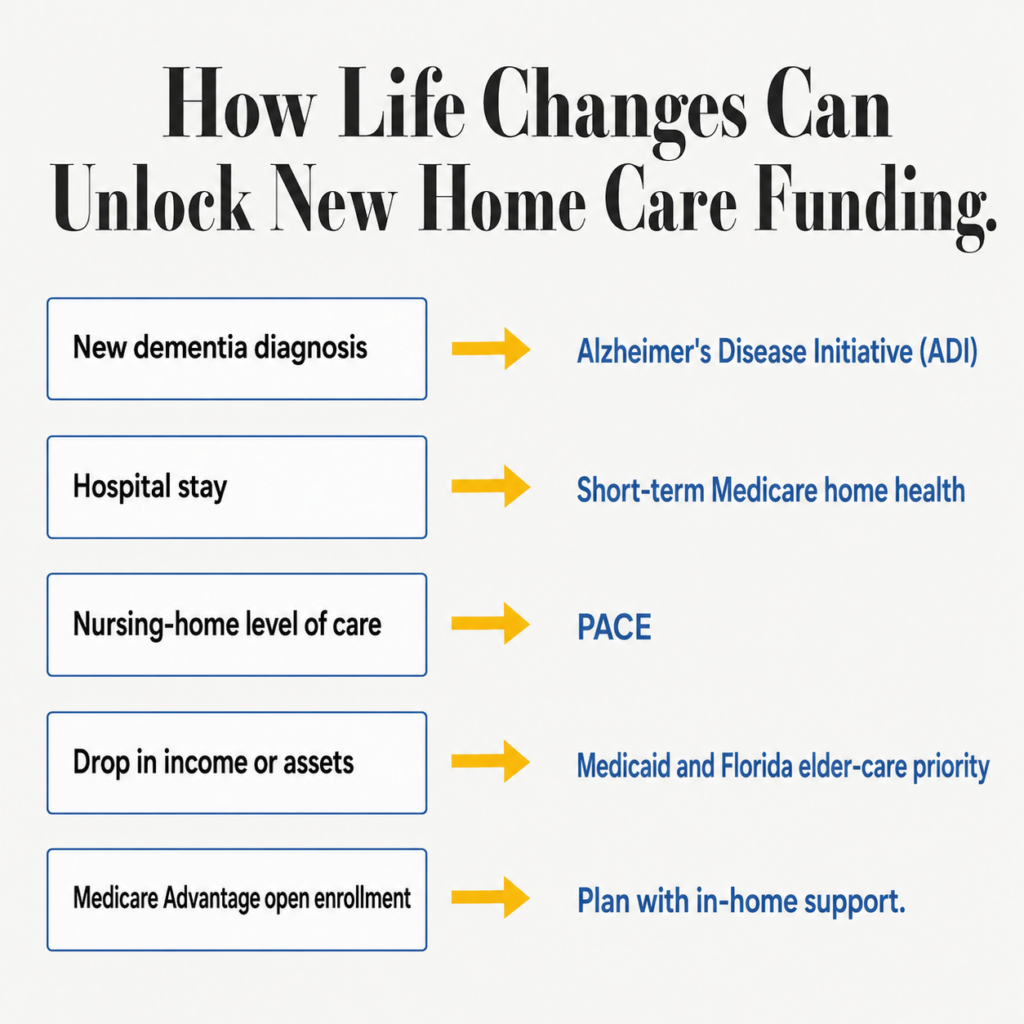
The way a family pays for care rarely stays the same. A new dementia diagnosis can open ADI. A hospital stay can trigger short-term Medicare home health. Crossing into nursing-home level of care can open PACE. A drop in income or assets can open Medicaid and Florida elder-care priority. The annual Medicare Advantage open enrollment window is the moment to switch to a plan with in-home support benefits.
Most agencies hold few or none of these contracts, which can force a family to switch providers, and caregivers, when their funding source changes. We hold contracts across the VA, multiple Medicare Advantage plans, PACE, and four Florida Department of Elder Affairs programs, so the same caregivers can often stay in place as funding shifts or stacks. Our paying for care page covers these options in more detail.
Frequently Asked Questions
Does Medicare pay for 24-hour home care in Florida?
No. Original Medicare does not cover 24-hour-a-day care at home, and it does not cover ongoing custodial care when that is the only care a person needs.
Can a veteran get home care at no cost in Florida?
Often yes. Eligible veterans may receive VA-funded home care at zero out-of-pocket cost through the Homemaker and Home Health Aide program or Veteran-Directed Care, as long as the agency holds a VA contract.
What is the income limit for Florida elder-care programs?
Limits vary by program. CCE uses functional impairment with a sliding-scale co-payment, while HCE follows Institutional Care Program income and asset limits. The Elder Helpline at 1-800-96-ELDER screens callers for eligibility.
How much does home care cost per hour in Florida?
The CareScout 2025 survey put the Florida median at about $32 per hour for a home health aide. Rates vary by agency depending on caregiver screening, training, and which insurance or state programs an agency is contracted with, and agencies with deeper background screening and broader payer contracts often run above the state median. Actual rates vary by hours and level of support, so a consultation gives the real number for your situation.
Does Medicare Advantage cover personal care at home?
Sometimes. Some plans include in-home support as a supplemental benefit, but coverage varies by plan, county, and year. Call your plan to confirm covered hours and in-network agencies.
Sorting Through Your Options
Paying for home care in Florida usually comes down to matching the right program to your situation, and that picture can shift as needs change. If you are weighing these options for a loved one and want help understanding which paths you may qualify for, our team at Seniors Helping Seniors® Suncoast Senior Care can walk you through home care in Sarasota and Manatee County and what each option would cover. Call us at 941-877-1000 to talk through your situation with no obligation and get a real quote for your family’s needs.